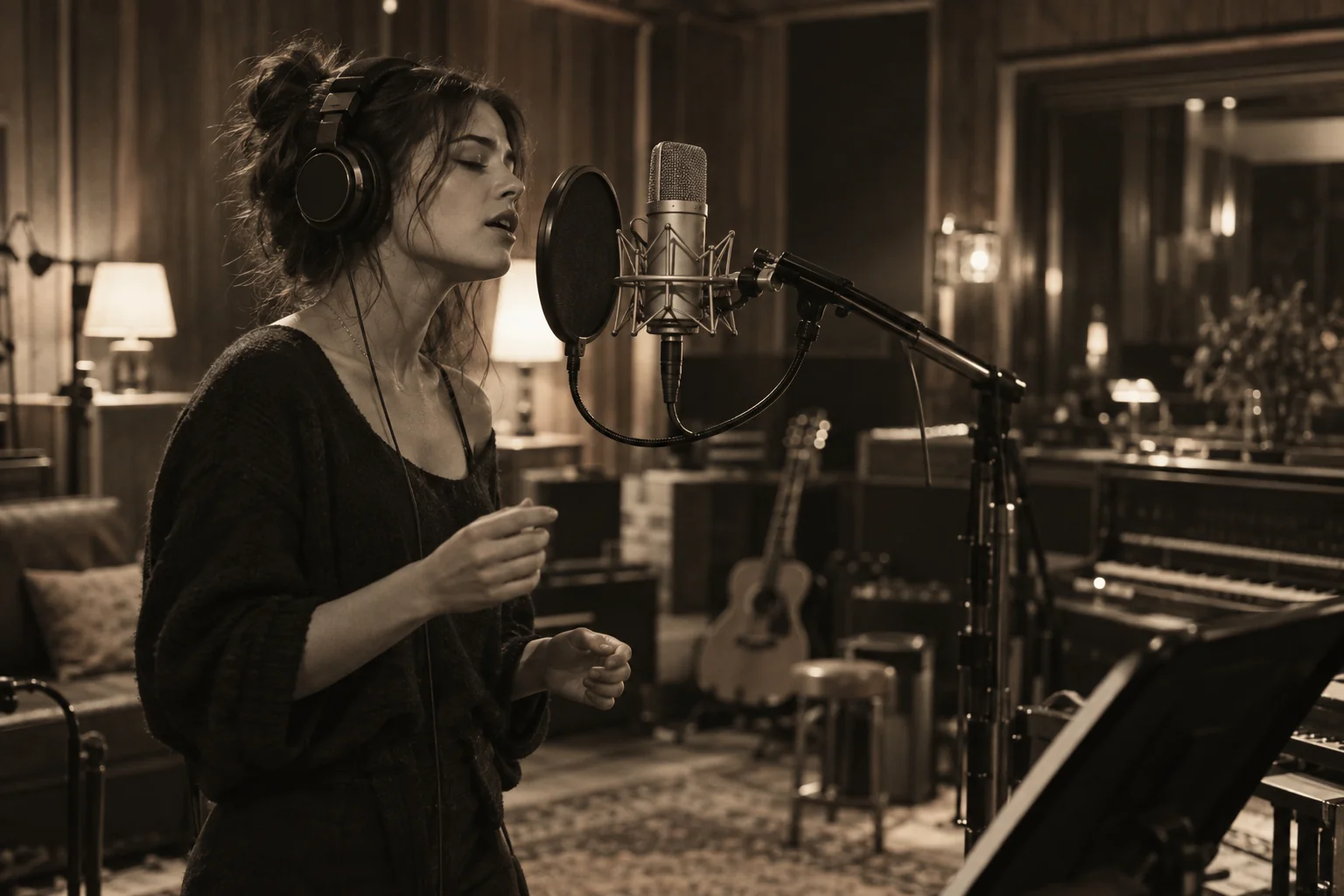
Soprano is one of the six main classical voice types. Compare it with all six vocal ranges, or see them on the vocal range chart.
Soprano vocal range: about C4–C6
C4 — middle C, 261 Hz — is the standard floor, and C6 is the ceiling in most references. Choir parts often use a narrower range than the full reference span. Check the actual score: soprano is the top part in SATB harmony, but the highest required note changes from piece to piece.
Below the floor, most sopranos can reach down to around A3 or B♭3, a step or two under middle C. Those notes tend to be softer and carry less colour, which is why they count for less in the music — a soprano can sing them, but they aren't where the voice lives. Some operatic roles reach C6 or higher. That is a repertoire demand, not a prerequisite for a beginner to explore a soprano-like voice.
The number that matters more than either endpoint is the tessitura — the band where the voice has its best colour, easiest volume and least effort. A soprano and a mezzo-soprano can share almost identical extremes on paper and still be different voice types, because the comfortable middle sits in a different place. A soprano's comfort zone is high.
What a soprano sounds like
Bright, forward and light at the top, with the ring that lets the voice sit on top of an orchestra or a band without a microphone. The upper range still needs training and control: even tone through the passaggio matters more than forcing a high note.
Classical singing divides sopranos into five generally recognised sub-types, and the dividing line is mostly weight and agility, not range:
| Sub-type | Character | Where you hear it |
|---|---|---|
| Coloratura | Light and extremely agile; fast runs and high staccato | Queen of the Night, The Magic Flute |
| Soubrette | Light and bright, mid-range tessitura, little coloratura | Susanna, The Marriage of Figaro; Zerlina, Don Giovanni |
| Lyric | Warm and full, higher tessitura than a soubrette | Mimì, La bohème; the Countess, Figaro |
| Spinto | A lyric voice that can be pushed to big climaxes | Aida; Leonora, Il trovatore |
| Dramatic | Powerful and dark, sits lower, carries over a full orchestra | Brünnhilde, The Ring; Turandot |
Coloratura splits further into lyric and dramatic coloratura, and two intermediate labels — Dugazon and Falcon — sit between soprano and mezzo, closer to the mezzo side.
Three related words are worth knowing so they don't confuse you. A sopranist is a male singer who can sing in the soprano range; a treble is a boy soprano; a castrato was the historical category of castrated male singers who took the soprano and mezzo roles. None of those is what "soprano" normally means today, which is a female voice type.
Soprano vs mezzo-soprano vs alto
Soprano vs mezzo-soprano is the distinction that matters most, and the one most often got wrong. The two can share the same low notes and the same top notes on paper. The difference is where the voice is comfortable and where it rings: a mezzo's best notes sit lower, in the middle of the usable range; a soprano's sit up in the top third. The common error runs in one direction — singers who can touch a high C often call themselves sopranos, when the rest of the voice, the part that has to stay full through a whole phrase, says mezzo. If you're testing that line, read mezzo-soprano vocal range next to this page and sing the same phrase on both.
Soprano vs alto is a different kind of comparison, because alto is a choral part rather than a voice type. In four-part harmony the soprano takes the top line, which often carries the melody, while the alto takes the line below it. Most of the voices singing the alto part are mezzo-sopranos, with the lowest notes going to true contraltos. So "I sing alto in my choir" tells you which line you stand on, not which voice type you are — a singer may be assigned an alto part when it is comfortable and the choir needs that line.
The practical rule: a voice type comes from the whole instrument — range, tessitura, colour and weight — not from a choir part and not from a single note.
How to tell if you are a soprano
These are observations to discuss with a teacher, not a score or a diagnosis. Warm up, use a comfortable volume, and stop any note that needs squeezing or shouting.
- Your upper-middle phrases feel comfortable at a moderate volume, rather than only when you push.
- You can repeat a high phrase with steady tone; touching one high note once is less useful evidence.
- Your lower phrases tend to lose body sooner than your upper-middle ones. Do not force them louder.
- Record the same short melody in a few nearby keys and note where the entire phrase feels easiest.
- Compare your comfortable stretch with both soprano and mezzo-soprano; their total ranges overlap.
- Treat your microphone result as a range measurement. A teacher also listens to tone and register transitions.
Use the vocal range test to record the notes you can hold for about two seconds. Then write down where a short phrase feels easiest. An endpoint result is a starting point; range, tessitura, colour and vocal weight need to be heard together.
Famous sopranos
Classical
| Singer | What to listen for | Documented range | Source |
|---|---|---|---|
| Diana Damrau | Compare the agility of the Queen of the Night with the longer phrases of Violetta. Her official biography identifies her as a soprano and lists both roles. | — | Official biography |
| Erin Morley | Hear the light, agile soprano writing for Olympia in Offenbach's Les Contes d'Hoffmann. | — | Metropolitan Opera production |
Pop and jazz
Whitney Houston, Mariah Carey and Minnie Riperton are useful listening examples for contrasting an upper belt, runs and whistle notes. Those techniques do not establish a classical soprano classification. A recorded high note is evidence of a performance, not a complete assessment of the singer's voice.
Note-by-note ranges quoted online for famous singers are almost always fan estimates. No exact personal range is claimed in this table. Listen to the phrase and its colour, rather than measuring yourself against a celebrity's highest note.
Soprano songs and repertoire
Classical
| Piece | Why it sits in the soprano repertoire | Verified edition range |
|---|---|---|
| "Der Hölle Rache kocht in meinem Herzen" — Mozart, The Magic Flute | The Queen of the Night's Act II aria, and a coloratura soprano part. It's built on repeated staccato notes in the upper register — the clearest demonstration anywhere of what "soprano writing at its extreme" means. | — |
| "O zittre nicht, mein lieber Sohn" — Mozart, The Magic Flute | The Queen's earlier aria: softer, slower, but the same high-lying demands. | — |
| "Casta Diva" — Bellini, Norma | A long, spun bel canto line that tests breath control and legato more than the top. | — |
| "Sempre libera" — Verdi, La traviata | Violetta's aria: coloratura fireworks and the low end of soprano writing inside the same piece. | — |
| "Un bel dì vedremo" — Puccini, Madama Butterfly | Lyric-to-spinto — a voice that has to stay full while the orchestra swells underneath. | — |
| "O mio babbino caro" — Puccini, Gianni Schicchi | Short, lyric, and sitting in the middle of the usable range: proof that soprano repertoire isn't all high Cs. | — |
| "Je veux vivre" — Gounod, Roméo et Juliette | Lyric coloratura: fast, bright, girlish writing with a high tessitura. | — |
| "Les oiseaux dans la charmille" — Offenbach, Les Contes d'Hoffmann | Olympia’s Doll aria: agile coloratura and high staccato writing. See the Met performance. | — |
| "Liebestod" — Wagner, Tristan und Isolde | Dramatic soprano writing: sustained power over a huge orchestra rather than agility. | — |
| "Popoli di Tessaglia!" — Mozart | A concert aria that climbs to G6, the outer edge of what the soprano voice has been asked to sing. | — |
Exact note spans depend on the score, edition, transposition and any performance additions. A dash means no specific edition has been verified here. Use these as listening references, then check your own score before choosing a practice piece.
A note on casting: roles and voice types overlap, and editions or transpositions can change the demands. A shared composer or opera does not make two different arias interchangeable. Check the named character and the specific score.
Pop and jazz songs
These are songs used to show off an upper register, not pieces written for one voice type:
- "Lovin' You" — Minnie Riperton (whistle register)
- "Emotions" — Mariah Carey (whistle notes)
- "I Will Always Love You" — Whitney Houston
- "All by Myself" — Céline Dion
- "The Voice Within" — Christina Aguilera
- "Into You" — Ariana Grande
Recorded versions involved studio editing, and each singer's comfort zone differs from the written line — treat these as showcases, not as range specifications.
Frequently asked questions
A few things to know before you sing.
What is the highest note a soprano can sing?
C6 is the upper endpoint of the typical reference span, not a universal ceiling. Some coloratura repertoire goes higher; individual singers differ.
What is the difference between soprano and mezzo-soprano?
Tessitura, colour and vocal weight matter alongside range. A soprano generally works comfortably higher, but the two types share many notes.
Can a soprano sing low notes?
Yes. Many have notes below C4. Their presence does not settle voice type; listen to how consistently the tone carries through a phrase.
How many octaves is C4–C6?
Two octaves: C4 to C5 is one, and C5 to C6 is another.
Can a soprano sing alto in a choir?
Sometimes, if the actual part is comfortable. Choir placement reflects the score and ensemble needs and does not determine your solo voice type.
Related
- All six vocal ranges explained
- Vocal range chart
- Mezzo-soprano vocal range
- Alto vocal range
- Contralto voice type
- Take the vocal range test — measure your usable low and high notes.
Sources & range conventions
The ranges on this site are approximate classical reference spans, not limits or audition requirements. Published ranges vary with repertoire and classification system. No individual singer’s exact range is inferred from a voice-type label.